FEP vs. PTFE Hose: Why PTFE Is Often the Better Choice by HoseChoice™
Nov 11th 2026
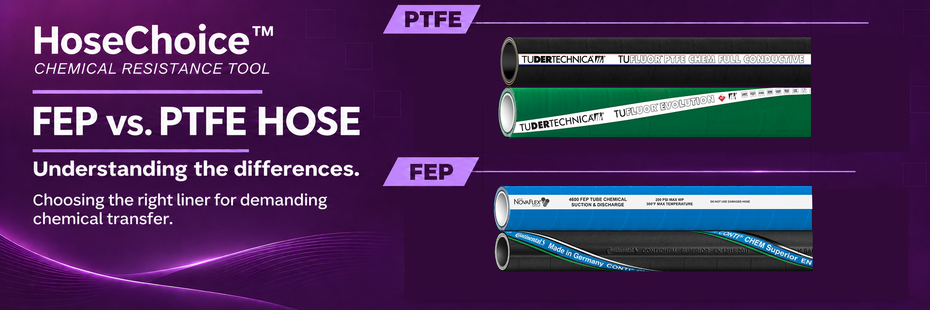
FEP vs. PTFE Hose: Why PTFE Is Often the Better Choice for Demanding Applications
When selecting a chemical transfer hose, the inner liner deserves close attention. It contacts the process fluid directly, so its compatibility and temperature capabilities are essential to selecting the right assembly.
FEP and PTFE are both fluoropolymers known for excellent chemical resistance and low-friction surfaces. Although they share many useful properties, they are not interchangeable in every application.
For demanding service, particularly at elevated temperatures, PTFE can offer an important advantage.
What Is FEP?
FEP stands for fluorinated ethylene propylene. It offers broad chemical resistance and can be melt processed, allowing manufacturers to extrude and mold it into various shapes.
FEP can also provide transparency in suitable tubing constructions, making it useful when visual observation of the fluid is important. That benefit may not apply to a reinforced hose with an opaque outer cover.
What Is PTFE?
PTFE stands for polytetrafluoroethylene. It combines broad chemical resistance with high temperature capability and a low-friction surface.
These characteristics make PTFE a strong candidate for chemical transfer and process applications that require a chemically resistant liner under demanding operating conditions.
Where PTFE Has the Advantage
Higher Temperature Capability
The clearest distinction is heat resistance. PTFE resins commonly have service temperature capabilities up to approximately 500°F (260°C), compared with approximately 400°F (205°C) for FEP.
For a process approaching the upper temperature limits of FEP, a properly rated PTFE hose may provide a better solution.
These figures describe polymer capabilities, not the working limits of every hose. Always follow the finished assembly’s published temperature and pressure ratings.
More Options for High-Temperature Processes
PTFE’s higher temperature capability can make it a better candidate when a hose must accommodate both chemical exposure and elevated process or cleaning temperatures.
However, the liner is only one part of the assembly. Reinforcement, covers, fittings, seals, and attachment methods must also meet the application requirements. Steam cleaning suitability must be confirmed for the specific hose.
Flexibility and Handling in Rubber-Covered Chemical Hoses
When comparing rubber-covered PTFE and FEP chemical hoses, flexibility depends on the complete construction, including liner thickness, reinforcement, rubber cover, and hose diameter.
A PTFE-lined design may offer easier handling and a tighter minimum bend radius than a comparable FEP-lined hose. This can make routing around equipment and connecting transfer lines more convenient. However, that advantage must be confirmed by comparing the specific products rather than the liner materials alone.
For a useful comparison, review hoses of the same inside diameter and suitable pressure rating. Consider minimum bend radius, hose weight, and the effort required to bend and move the assembly.
Does PTFE Always Have Better Chemical Resistance?
Both materials offer excellent resistance to a broad range of chemicals. PTFE’s higher temperature capability does not automatically mean FEP is chemically unsuitable.
Compatibility must be checked against the actual chemical, concentration, temperature, and exposure conditions. Neither material should be treated as universally compatible with every fluid.
When FEP May Be the Right Choice
An FEP-lined hose can be an excellent option when it meets the chemical compatibility and operating requirements of the application.
Likewise, transparency can be useful in FEP tubing where the construction allows fluid visibility. Selecting PTFE solely because it has a higher temperature ceiling may provide little benefit if the application does not require it.
Compare the Complete Hose Assembly
Before choosing either material, confirm:
-
The chemicals being transferred and their concentrations
-
Normal and maximum operating temperatures
-
Working pressure and vacuum requirements
-
Required flexibility, movement, and minimum bend radius
-
Cleaning procedures and temperatures
-
Fitting and seal compatibility
-
Any requirements for static dissipation or permeation control
The liner material alone does not establish pressure capability, flexibility, service life, or resistance to permeation.
Find Compatible Hose Options With HoseChoice
Understanding the difference between FEP and PTFE is a useful starting point. The next step is checking compatibility with the actual chemicals you plan to transfer.
Our HoseChoice™ Chemical Compatibility Tool helps simplify that process by bringing chemical compatibility information and hose options together in one place.
Search for your chemical and compare compatibility ratings across different hose materials, including FEP, PTFE, EPDM, UHMWPE, and XLPE. You can also review gasket and fitting materials, helping you look beyond the hose liner when selecting an assembly.
HoseChoice helps you:
-
Narrow down hose options based on the chemicals being transferred.
-
Compare materials rather than choosing by price or appearance alone.
-
Consider compatibility across the hose, gaskets, and fittings.

Explore HoseChoice to find compatible hose options for your application.